Textile Construction · Throws
How Honeycomb Weaves Shape Lightweight Throws
A honeycomb weave makes texture do more than decorate. Its raised cells and recessed channels give cloth a distinctive hand, a shifting play of light and shade, and a drape that can feel airy without seeming insubstantial. In a throw, those qualities influence how the fabric looks on a chair, settles across a bed, and feels when drawn around the shoulders.
A pattern built into the cloth
Honeycomb is a woven structure, not a print applied to a flat surface. Its name describes the small, cell-like shapes visible in the finished fabric. The pattern is created by the way warp and weft yarns interlace: some parts of the weave form raised areas, while adjacent sections sit lower. Repeated across the fabric, these changes produce a relief that recalls a honeycomb without needing to reproduce one exact shape or scale.
In woven cloth, the warp yarns run lengthwise on the loom; the weft passes across them. A plain weave alternates over and under in a simple, regular sequence. A honeycomb construction uses a more varied arrangement. The interlacing changes across planned groups of yarns, encouraging parts of the cloth to rise or recede. The precise pattern depends on the weave draft, yarns, loom setup, and finishing. As a result, “honeycomb” names a family of textured effects rather than one universal recipe.
That distinction matters when comparing textiles. Two throws can both be described as honeycomb woven yet differ in cell size, depth, density, softness, and weight. One may have fine, shallow texture; another may show pronounced pockets and a more sculptural surface. The label offers a clue to construction, not a complete specification of how the finished cloth will perform.
The pattern is visible, but its influence is also tactile. Run a hand across a honeycomb surface and the fingers encounter alternating ridges and valleys. The change in height catches fingertips and light. A smooth, flat weave tends to present a more uniform plane; honeycomb gives the eye and hand a sequence of small variations. It is a quiet architectural detail: texture formed by structure rather than ornament added afterward.
Why texture can feel light
“Lightweight” is often used as if it described a single property. In practice, it can refer to a textile’s actual mass, its thickness, the way it hangs, or the sensation of wearing or holding it. These qualities overlap, but they are not interchangeable. A thick fabric can have a graceful drape; a low-mass cloth can still feel stiff. Weave, fiber, yarn size, finishing, and dimensions all contribute to the impression.
Honeycomb texture can make a fabric seem airy because the surface is not uniformly flat. Raised and recessed areas create a more dimensional hand, while the construction may leave the cloth with a flexible character. Depending on the yarns and density, that flexibility can help a throw fall into soft folds rather than hold a rigid shape. It may also create an impression of loft without requiring a heavy, padded filling.
But the word “honeycomb” alone does not guarantee breathability or a particular level of warmth. Those depend on the whole textile. Fiber content influences moisture interaction and touch; yarn thickness and spacing affect the fabric’s openness; and finishing can change softness and surface feel. A compact, dense honeycomb weave may behave differently from a more open version. The most reliable description comes from considering weave and fiber together, not treating either as a promise on its own.
In everyday use, the practical appeal is often balance. A throw should be comfortable enough to reach for, but not so heavy that it feels cumbersome. It should add a layer when a room feels cool, while remaining easy to fold over a sofa arm or spread across the foot of a bed. Textured construction can contribute to that sense of adaptable comfort. It does not replace insulation, and it cannot control the temperature of a room, but it can make a light layer feel considered and inviting.
How a throw is used changes the experience. Draped loosely over the shoulders, it needs to move with the body. Folded across a bed, it becomes a visible band of texture as well as an extra layer. On a sofa, it must settle around cushions without looking overly formal. A supple honeycomb cloth can serve all three roles because its surface has definition while its folds remain relaxed.
Fiber and weave are partners
Weave describes how yarns cross; fiber describes what those yarns are made from. Neither tells the whole story alone. A honeycomb pattern in linen will not feel identical to one woven in cotton, wool, or a blend. Differences in fiber length, yarn construction, spinning, and finishing help determine whether the surface feels crisp, soft, springy, smooth, or nubby.
Linen is made from flax fibers. In a throw, it can bring a dry, natural hand and a characteristic irregularity that gives the surface visual life. Linen is also known for its strength as a plant fiber, though the durability of an individual textile depends on its construction and care as well as the fiber itself. A linen honeycomb weave combines the grain of the yarn with the relief of the pattern: the texture is not simply a geometric effect, but the meeting of structure and material.
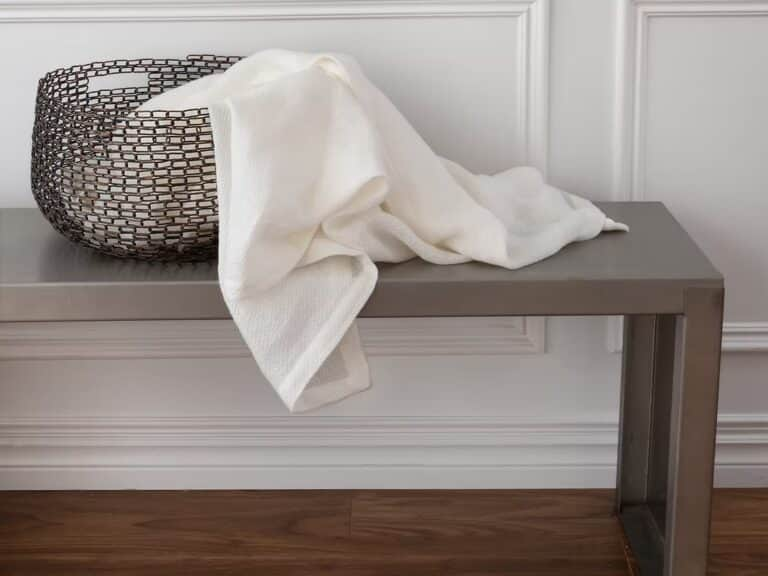
A useful real-world example is the St Geneve Avalon Linen Throw. It is described as woven in Portugal from 100% linen and sewn in Canada. Its honeycomb weave is presented as the source of a soft texture and graceful drape, with a design intended to feel light while offering a comfortable layer. The throw measures 49 by 70 inches, a size suited to use over a chair, across a sofa, or at the foot of a bed.
The Avalon also illustrates why construction details matter beyond the weave name. Its product description notes a one-inch self hem and mitered corners. Those finishing choices give the edges a clear, tailored boundary, while the textured field remains the visual focus. The result is a combination of surface and outline: the honeycomb pattern lends dimension, and the edge treatment helps the throw keep a composed shape when folded or draped.
Fiber and weave should therefore be read as a pair. If the question is whether a throw feels soft, consider the fiber and finishing, not only the pattern. If the question is whether it drapes freely, look for details about dimensions, weight, and construction, and—when possible—handle the fabric. Product descriptions can establish useful facts, but tactile qualities remain personal and can vary with use and laundering.
The everyday life of a textured throw
A throw earns its place through repetition. It is picked up, refolded, moved from room to room, and sometimes washed after an accidental spill or a season of regular use. A pronounced texture can make those ordinary encounters more satisfying: the cloth has a clear identity even when it is folded simply. At the same time, a textured surface calls for thoughtful handling, because raised yarns can encounter friction or snag on rough hardware.
Honeycomb’s relief also affects how a throw appears in a room. Light grazes the high points and settles in the recesses, so the surface can look subtly different through the day. In a pale neutral, the pattern may register mostly as shadow and depth. In a stronger color, the same structure can make the cloth feel more dimensional. This visual movement is one reason texture can add character without relying on a bold print.
For styling, a few practical principles go a long way:
- Let the weave remain visible. Fold the throw loosely or drape it so the textured surface is not hidden beneath several tight layers.
- Balance texture with simpler materials. Honeycomb can sit comfortably beside smooth cotton, plain upholstery, or a flat-woven rug without every surface competing for attention.
- Consider scale. A larger, more pronounced pattern may become a focal point; a finer texture can work like a quiet neutral.
- Choose a useful location. A throw placed within easy reach is more likely to serve its everyday purpose than one kept permanently arranged as a display piece.
These are not rules about a single decorating style. The point is to notice what the weave already contributes. A honeycomb throw has built-in texture, so it can provide interest even when its color is restrained. On a bed, it can create a visual boundary between smooth sheets and a heavier cover. On a sofa, it can soften a clean-lined setting. Used casually, it adds a small note of irregularity to a room of precise edges.
Comfort, meanwhile, is more than appearance. A lightweight layer may be useful in a temperate room, during a cool evening, or when a full blanket feels like too much. People experience warmth differently, and no weave can guarantee the same comfort for everyone. A throw is best understood as a flexible layer whose usefulness depends on the room, the season, and the person using it.
What to look for when evaluating a honeycomb weave
When comparing throws, begin with the complete description. Fiber content is a basic fact, but it should be accompanied by information about size, construction, finishing, and care. If weight is listed, it may help distinguish a finer layer from a more substantial one. If it is not listed, terms such as “lightweight” or “airy” are impressions rather than standardized measurements, so treat them as guidance rather than a precise technical rating.
Next, consider the texture itself. A clear honeycomb pattern should show repeated raised and recessed areas. The cells need not be perfectly identical: yarns are not always visually uniform, and natural fibers can have small variations. What matters is whether the overall surface looks and feels coherent. A close inspection can reveal whether the raised areas are formed by the weave or whether the texture comes from a separate finish.
Edges deserve attention, too. The perimeter receives more handling than the center and often tells you about the care taken in finishing. A hem, selvedge, or other edge treatment can affect how a throw looks when folded, as well as how it holds together in regular use. The Avalon’s self hem and mitered corners provide one example of a deliberate finish; different designs may use different methods, each with its own look.
Finally, match the textile to its intended role. A decorative layer used occasionally has different demands from a throw that will be carried around the home every day. Think about who will use it, where it will live, whether it needs to be machine washable, and how much time you are prepared to give its care. A beautiful texture is most valuable when the care routine and intended use are realistic.
A quick evaluation checklist
- Confirm the stated fiber content.
- Check dimensions against the intended use.
- Look for information about weave, finishing, and weight.
- Read care instructions before choosing a daily-use textile.
- Consider whether the surface and color fit the room’s existing textures.
A question worth asking
Does the throw’s appeal come from the actual construction and material, or only from a description? When possible, handle the fabric, inspect the back and edges, and compare how it folds with other textiles you know.
Care that respects the surface
Textile care is not a one-size-fits-all exercise. Fiber content, weave, dyes, finishes, and the maker’s instructions all matter. The first step is to follow the care label or product guidance, even when a general rule for linen or throws suggests something else. A textured textile can be strong in ordinary use and still be vulnerable to an overloaded wash, harsh chemicals, or an over-hot drying cycle.
For the Avalon, the stated guidance emphasizes room for the fabric to move in the wash, sufficient water, and a small amount of detergent. It advises against fabric softener, bleach, detergents containing bleach or whiteners, and alkaline detergents. It also recommends medium-temperature washing and drying rather than hot settings, and warns against over-drying. These instructions are specific to the product and should take priority over generic assumptions about linen care.
There is a practical reason to avoid crowding a textured throw into a packed machine. When cloth has too little room, it can rub and twist against other items, increasing the chance of tangling or snagging. The Avalon’s guidance recommends washing with adequate water and avoiding overcrowding; it also suggests using a fabric bag to help prevent snags. Such precautions are simple, but they can reduce unnecessary stress on the surface.
Detergent buildup is another concern addressed in the care instructions. Using more soap does not necessarily produce a cleaner textile. Excess detergent may not rinse away completely and can leave residue that affects the feel of the fabric. Fabric softener may also change the hand of a textile, so it is best not to add it when the manufacturer advises against it. Follow the directions for the specific item rather than reaching automatically for familiar laundry products.
Drying deserves the same restraint. Heat and prolonged tumbling can place avoidable strain on fibers and finished edges. The Avalon instructions advise medium-temperature settings and caution against over-drying. Remove the throw when it is dry according to the care guidance, then fold or drape it without forcing the honeycomb surface into a tight, compressed shape for long periods.
Between washes, ordinary habits help: keep the throw away from sharp fasteners and rough surfaces that can catch raised yarns, and shake or refold it gently when needed. Do not pull a loose thread; cutting or tugging it may worsen the problem. For more significant damage or uncertainty about a stain, consult the maker’s instructions or a qualified textile-care professional rather than experimenting with aggressive spot treatments.
The small engineering behind quiet comfort
A honeycomb weave is a reminder that comfort in a textile is not always delivered by thickness. It can come from the way yarns are organized, the way the cloth responds to movement, and the way its surface meets the hand. A raised pattern gives a throw presence; a flexible construction lets it settle. When these qualities work together, the result feels useful rather than merely decorative.
That does not make every honeycomb throw interchangeable. Fiber, density, yarn, finishing, size, and edge construction all leave their mark. The pattern offers a starting point for understanding the cloth, not a substitute for looking closely at the whole object. A thoughtful choice considers what the throw is made of, how it is woven, where it will be used, and whether its care needs fit the household.
The St Geneve Avalon brings those questions into focus: a 100% linen throw, woven in Portugal and sewn in Canada, with a honeycomb surface, a one-inch self hem, mitered corners, and dimensions of 49 by 70 inches. Its design shows how a textured weave can sit at the intersection of comfort and everyday function. The construction shapes the feel and fall of the cloth; the linen gives it a distinct material character; and considered care helps preserve both.
In the end, honeycomb’s appeal is straightforward. It transforms a plane of fabric into a surface with rhythm—raised, recessed, light-catching, and tactile. For a lightweight throw, that rhythm can provide visual depth and a supple drape without demanding heavy ornament. The result is a textile made for ordinary moments: an extra layer within reach, a soft edge on a carefully made bed, or a familiar piece of cloth moved from one room to another.