Textiles & Craft
St Geneve Avalon: Craftsmanship Across Two Countries
A throw can carry more than a pattern. Its story may travel from fiber selection to loom, from loom to cutting table, and from one country to another. The St Geneve Avalon offers a clear example: woven in Portugal from linen and sewn in Canada, it brings together stages of textile production that are often compressed into a single phrase on a label.
Published October 30, 2026
In a finished textile, the evidence of making is quiet. It is in the way a surface catches the light, the way an edge holds its shape, the way a fabric falls over a chair without looking stiff or collapsing into a heap. Those qualities are the result of decisions made at different points in production. A fiber becomes yarn; yarn becomes cloth; cloth is cut, finished, and given its final dimensions. When those stages take place across borders, the product label becomes a small map of the work.
The St Geneve Avalon Linen Throw is described as woven in Portugal and sewn in Canada, using 100% linen. That information is specific, but it is not a complete account of the textile’s life. It does not, by itself, identify where the flax was grown, where the yarn was spun, which finishing processes were used, or every facility involved. It does tell us that weaving and sewing—the conversion of yarn into cloth and cloth into a finished throw—took place in two different countries.
That distinction matters. Consumers often encounter origin statements as shorthand for quality, tradition, or sustainability. Such associations can be meaningful, but they should not replace closer reading. Country of weaving is one fact. Fiber content is another. Construction, finishing, care, and traceability add further pieces. Together they give a more useful picture of what a throw is, how it may behave, and what questions remain open.
A label is a beginning, not the whole story
Textile production is a sequence rather than a single event. For a linen throw, the chain may begin with flax cultivation. The plant is harvested and processed so that usable fibers can be separated from the stem. Those fibers are prepared and spun into yarn, which is then woven into fabric. The cloth may be washed, softened, dyed, or otherwise finished before it is cut and sewn into the dimensions and shape of the final item.
Not every maker performs every stage in one place. A business may source fiber from one region, yarn from another, weave cloth in a third, and complete the product somewhere else. This division of work is common across modern manufacturing, where specialist equipment and expertise are distributed among suppliers. The arrangement can make production more flexible, but it also means that a simple “made in” description may refer to only one part of a longer process.
For Avalon, the available product information identifies Portuguese weaving and Canadian sewing. Those statements point to two consequential stages. Weaving gives the fabric its structure; sewing turns that fabric into a usable throw, with finished edges and corners. They do not establish the origin of the flax or yarn. Nor do they reveal every detail of the supply chain. A careful reader can appreciate what is disclosed without assuming more than the information supports.
This is not a technicality. When origin claims are treated as interchangeable, consumers can mistake the location of final assembly for the origin of all materials, or assume a country name guarantees a particular standard of workmanship. Better questions are more precise: What stage took place where? What fiber is used? What construction is described? Which care instructions apply? What documentation supports any environmental or ethical claims?
What weaving contributes
Weaving interlaces two systems of yarn, commonly called warp and weft, to create a stable cloth. The arrangement, tension, yarn characteristics, and finishing all influence the fabric’s appearance and behavior. A plain weave, a twill, and a textured weave can use similar fibers yet produce markedly different surfaces and drapes. The word “linen” identifies a fiber, not a single texture or construction.
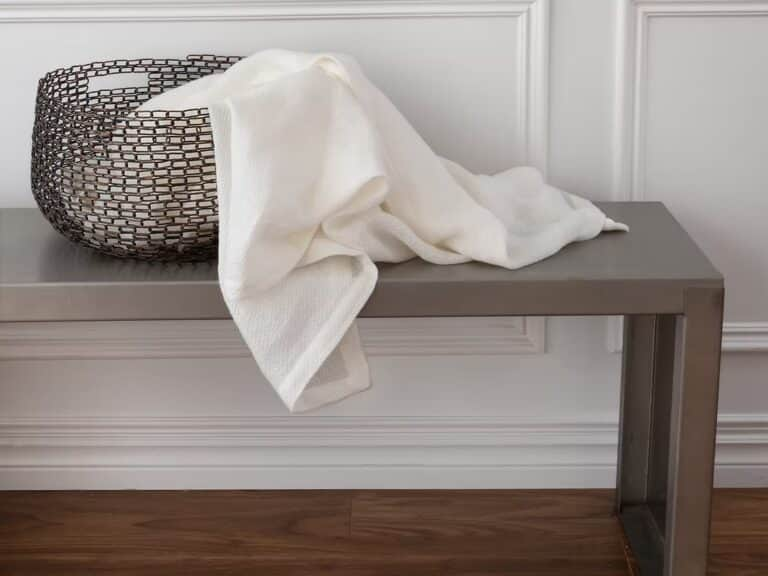
Avalon is described as having a honeycomb weave. In general, honeycomb structures create a raised, recessed surface that can feel dimensional rather than flat. The pattern is formed through the arrangement of yarns, not by adding a separate decorative layer. As with any woven cloth, the precise hand and performance depend on details such as yarn size, weave density, finishing, and the way the fabric is handled after it leaves the loom. A brief product description does not provide all those specifications, so it is sensible to treat the weave name as a useful clue rather than a full technical dossier.
The texture has practical as well as visual consequences. A patterned surface may feel different against the hand, catch light unevenly, and create a particular kind of drape. It may also require attention during laundering because textured cloth can snag if it rubs against hooks, zippers, or rough items. That does not make it fragile by definition. It simply makes handling and care part of the construction story.
For Avalon, the stated dimensions are 49 by 70 inches. That size helps establish its intended versatility: it can be laid across a bed, folded over a sofa, or kept close for an extra layer while reading or relaxing. A throw is not necessarily designed to perform like a heavy blanket. Its usefulness often lies in the balance between coverage, portability, and a manageable degree of warmth.
What sewing contributes
After fabric is woven and prepared, sewing gives it a finished form. Edges must be controlled so they do not unravel, and corners must be shaped to lie neatly. These may appear to be minor details beside the loom, but they influence how a textile withstands repeated handling. A well-considered hem can help stabilize the perimeter and make the throw easier to fold and maintain.
The Avalon product details describe a one-inch self hem and mitered corners. A self hem uses the fabric itself to finish the edge, rather than relying on a contrasting binding. Mitered corners are constructed so that the hem turns neatly at the corner, reducing bulk and creating a clean intersection. The measurements and exact finishing method are not a substitute for inspecting a particular item, but the terms indicate that the edge treatment has been considered as part of the design.
Sewing in Canada does not mean the fabric was woven there, just as Portuguese weaving does not establish where the fiber was grown. It does mean that the process of turning the woven cloth into this finished throw is attributed to Canadian production. That separation can be read as a practical production arrangement: textile-making expertise and garment or home-textile finishing need not be located under the same roof—or within the same national border—to contribute to one object.
It also invites a broader point about craftsmanship. The word can sound as if it describes a lone artisan performing every step. In contemporary textile work, craft may instead be distributed across specialized operations. The loom operator, finishing team, pattern planner, and sewing specialist may never work in the same place, yet each stage affects the result. Recognizing that network does not diminish craft. It makes its structure more visible.
Linen: fiber character and everyday use
Linen is made from flax fiber. It is known for a crisp hand when new, a distinctive natural texture, and a tendency to soften with use and washing when cared for appropriately. The fiber’s character is not uniform: yarn preparation, weave, finishing, and laundering all influence whether a linen textile feels smooth, textured, relaxed, or comparatively firm.
As a plant-based fiber, linen can be valued for breathability and moisture management, although comfort depends on the complete fabric and the conditions in which it is used. A lightweight woven throw may feel airy and adaptable, but it should not be understood as a technical temperature-control device. Room temperature, layering, weave density, and personal preference all shape the experience.
Linen’s familiar creasing is part of its behavior. The fiber does not always hold a pressed, immaculate surface in ordinary use, and a relaxed appearance is often considered part of its appeal. A textured honeycomb weave adds another layer to that visual character. The result is not simply “smooth white cloth,” but a surface with depth, movement, and the signs of natural fiber.
Durability also requires context. Linen is often regarded as a strong textile fiber, but no fiber is immune to wear. Repeated abrasion, overly forceful washing, heat, snagging, and harsh chemicals can damage a finished product. A throw used on a frequently occupied sofa may encounter different stresses from one folded at the foot of a bed. The best choice depends not only on fiber reputation but on how the item will actually be used.
How to evaluate a throw beyond its country names
Origin is valuable information, but it is only one dimension of evaluation. A shopper, student, or textile enthusiast can build a more complete assessment by considering several questions together:
- What is the fiber content? “100% linen” describes the stated fiber composition, while “linen blend” signals that other fibers are included. If a blend is listed, the proportions matter.
- What is the construction? Weave type, weight, dimensions, and finishing give clues about surface, drape, warmth, and intended use.
- Which production stages are identified? Distinguish where fiber was grown, yarn spun, fabric woven, and finished article sewn. These stages may occur in different places.
- How are edges and corners finished? Hem type, binding, seams, and corner construction can affect appearance and how the perimeter handles repeated use.
- What does the care label require? Practical care instructions are essential to preserving the fabric, especially where the product has a textured weave or carefully finished edges.
- Are broader claims supported with detail? Terms such as “responsible,” “sustainable,” or “ethical” are most useful when accompanied by clear standards, scope, and evidence.
These questions avoid the temptation to treat a country of manufacture as a universal scorecard. A place name can indicate where a particular operation happened, but it cannot, on its own, prove the quality of every other stage or the environmental performance of the entire supply chain. For that, more specific documentation is needed.
Care is part of construction
A textile’s lifespan is shaped not only at the mill or sewing table but at home. Care instructions are a form of product knowledge: they translate the material and construction into daily practice. For the Avalon throw, the supplied guidance emphasizes adequate water, a roomy wash, a small amount of detergent, and moderate temperatures. It also advises against fabric softener, bleach, detergents containing whiteners or alkaline ingredients, overcrowding, and over-drying.
Those recommendations make sense as a conservative approach to maintaining linen and protecting the finished textile. When a washing machine is crowded, fabric has less room to move, increasing friction and making rinsing less effective. Excess detergent can remain in the cloth, while aggressive bleach or high heat may affect fibers and color. Over-drying can leave textiles harsher than necessary and place additional stress on the material.
The instructions also recommend using a fabric bag to help prevent snags. This is especially relevant for a textured weave: a zipper, hook, or sharp edge in the same load can catch on raised yarns. The advice to wash the throw with sufficient water and avoid overloading is not an invitation to ignore the care label. Rather, it is a reminder that gentle conditions and space can matter as much as detergent choice.
Before washing any new textile, check its current sewn-in label and the manufacturer’s latest instructions. If the item is unusually soiled, has a stain, or is being washed in a machine with a different set of cycles, consider how those circumstances change the risk. Spot testing an inconspicuous area may be prudent when using any cleaning method not expressly described. Do not assume that a fabric’s natural origin makes every cleaning product or high-temperature method safe.
Drying deserves the same attention. The Avalon guidance calls for medium-temperature settings and warns against over-drying. Where the care label permits, air drying can reduce exposure to heat and mechanical action. If using a dryer, removing the throw before it becomes excessively dry may help preserve a softer, more relaxed hand. The goal is not to freeze linen in a showroom state; it is to avoid needless strain on a textile intended for repeated use.
A cross-border object in a connected industry
“Woven in Portugal, sewn in Canada” is a compact phrase with a larger implication: modern textiles are often made through connected systems, not enclosed national stories. The fabric’s transformation may pass through multiple specialized hands and facilities. For consumers, that reality can make provenance harder to summarize. For the industry, it allows production stages to be organized around skills, capacity, and supply arrangements.
The cross-border story also helps separate romance from useful knowledge. There is no need to invent a personal history for a product to make its manufacturing significant. The facts that are available are enough to open a conversation about how cloth becomes an object: first a fiber, then a yarn, then a woven surface, then a finished edge. Each transition leaves decisions in the material.
For a reader interested in textile craftsmanship, Avalon is an example worth examining precisely because its production details are stated plainly. Portugal is identified with weaving; Canada with sewing; linen with fiber content; honeycomb with surface construction; the one-inch self hem and mitered corners with finishing. These details do not answer every question, but they create a more meaningful account than a generic claim of luxury or quality could provide.
The St Geneve Avalon Linen Throw brings those particulars together in a 49-by-70-inch form intended for layering and everyday comfort. Its appeal rests not only in where two stages of production occur, but in the combination of linen, textured weave, considered edge finishing, and care guidance that helps a household understand how to maintain it.
Reading the object clearly
A throw is a modest object, but it is also a record of material choices. Its fiber determines much of its tactile character. Its weave shapes the surface. Its hem and corners show how the cloth has been finished. Its care instructions reveal how the maker expects it to be treated. Its origin details point to where certain stages took place—and, just as importantly, where the label leaves the story unfinished.
That is a more useful way to think about craftsmanship across two countries. Not as a slogan, and not as a guarantee attached to a passport, but as a sequence of work that can be examined piece by piece. In Avalon’s case, the journey described is specific: Portuguese weaving, Canadian sewing, linen fiber, honeycomb texture, and carefully stated care guidance. Each detail adds clarity. Together, they make the throw legible as both a household textile and the outcome of a distributed craft process.